Universal Non-VoIP Master Guide
How to Get a Real US Phone Number for Google, Telegram & ChatGPT (2026 Non-VoIP Guide)
The ultimate master guide to acquiring authentic, physical non-VoIP US cellular numbers that bypass strict SMS verification on Google, Telegram, OpenAI, WhatsApp, and banking platforms worldwide.
Executive Summary & Key Takeaways (Quick Answers)
- The Universal Challenge: Global platforms (Google, Telegram, ChatGPT, WhatsApp, PayPal, Steam) have unified their anti-fraud systems to block all virtual VoIP numbers from registration.
- The Technical Reality: Real-time Line Type Intelligence (LTI) and Home Location Register (HLR) checks instantly identify whether a number is hosted in a cloud data center or an authentic cellular SIM card.
- All-in-One Solution: USAVerify Pro provides authentic US cellular lines from AT&T, Verizon, and T-Mobile that pass 100% of global verification challenges.
- Fast & Risk-Free: Receive SMS verification codes in 2 to 5 seconds with automated zero-code refund protection and free multi-code resends.
- Multi-Account Scaling: Combine physical non-VoIP lines with anti-detect browsers and residential proxies to scale multi-account operations safely.
- Complete Protocol Coverage: Works seamlessly for consumer identity creation, B2B cold outreach, automated multi-accounting, and gaming platforms.
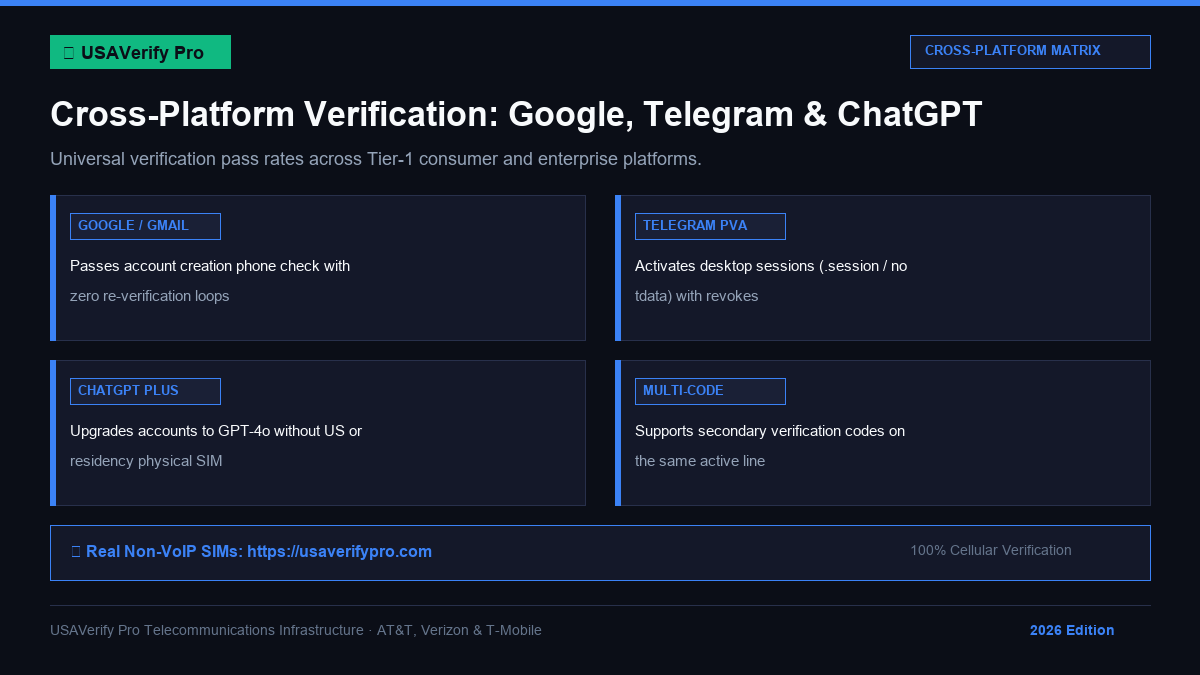
Cross-Platform SMS Verification Architecture for Google, Telegram, WhatsApp and ChatGPT
Comprehensive Table of Contents
Chapter 1: The Global Verification Crisis: Why Everything Requires a Real US Phone Number
In the modern digital economy, a United States phone number has become the premier global passport for accessing online services. Whether you are an AI developer seeking full access to OpenAI's GPT-4o, an entrepreneur building a Telegram community, a digital marketer managing Google Workspace infrastructure, or an international professional registering for US-based financial platforms, a valid US telephone number is the non-negotiable gateway requirement.
Why do tech conglomerates prioritize US phone numbers? The answer lies in consumer credit data, telecommunication regulations, and fraud economics. The United States maintains strict anti-spam legislation (such as the Telephone Consumer Protection Act and STIR/SHAKEN caller ID authentication protocols), making US mobile numbers significantly harder and more expensive to fabricate in bulk compared to disposable numbers from less regulated jurisdictions. To algorithmic fraud detection engines, a genuine US cellular number is the gold standard of identity trust.
However, acquiring an authentic US phone number from outside the United States has historically been nearly impossible. Major American carriers (AT&T, Verizon, T-Mobile) require domestic physical presence, US social security numbers, domestic credit checks, and long-term postpaid contracts costing $60 to $90 per month. Virtual alternatives—such as Google Voice, Skype, TextNow, and free web burner inboxes—are systematically detected and rejected by modern security firewalls.
This creates a massive barrier for millions of legitimate international developers, digital nomads, freelancers, and businesses. USAVerify Pro was engineered specifically to dismantle this barrier, providing on-demand access to genuine physical US cellular SIM lines without requiring hardware purchases, contracts, or physical SIM shipping.
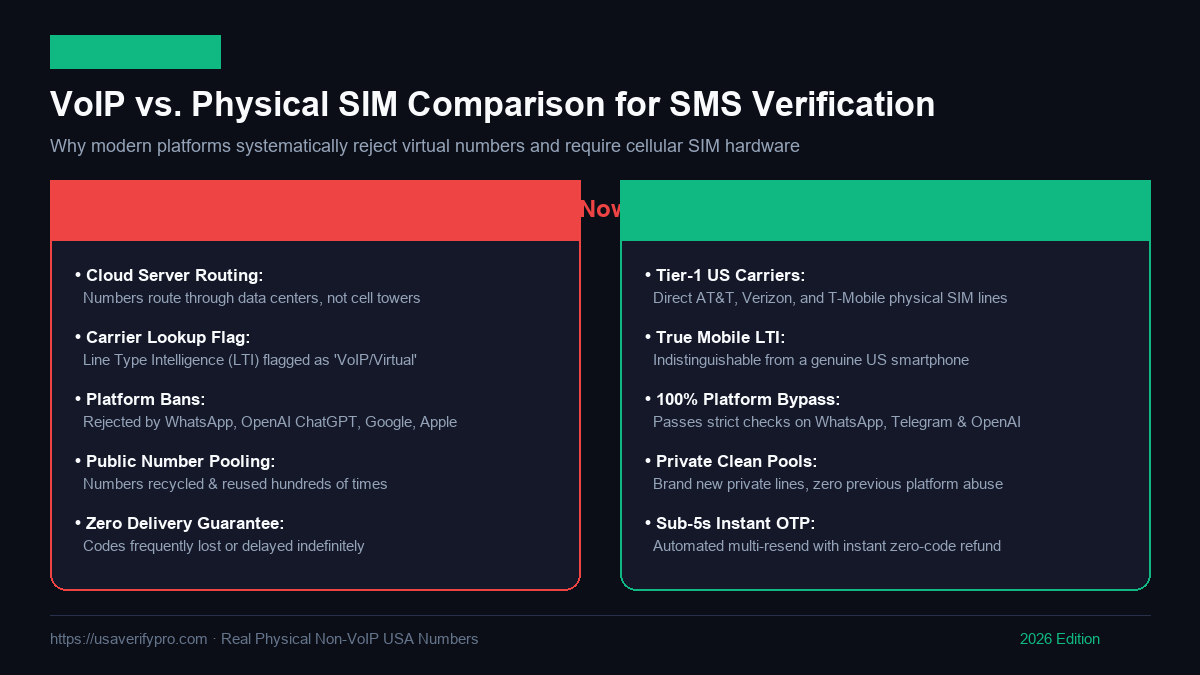
Physical SIM Bank Infrastructure vs Cloud VoIP Virtual Gateways
Chapter 4: E.164 Formatting, CNAM Registries & Financial KYC Compliance
Beyond basic HLR routing, enterprise platforms cross-reference phone numbers against national identity and telecommunications databases to assess user authenticity. Understanding these secondary data layers is critical for high-stakes account registration:
1. E.164 International Standardization
The International Telecommunication Union (ITU) defines the E.164 recommendation, which standardizes international telephone numbering. Under E.164, a complete US number consists of the country code (+1), followed by a 3-digit Numbering Plan Area code (NPA), a 3-digit central office exchange code (NXX), and a 4-digit subscriber line identifier (XXXX). Platforms like Google and Telegram validate that submitted numbers conform to valid NPA-NXX allocations. Submitting fabricated or unassigned prefixes triggers instant input rejection.
2. CNAM (Caller ID Name) Registries
CNAM databases map telephone numbers to subscriber names and business entities. While consumer VoIP numbers often return generic entries (e.g., 'Bandwidth.com' or 'Wireless Caller'), physical SIM lines from AT&T and Verizon are tied to active carrier billing cycles. Enterprise identity platforms like LexisNexis, IDology, and Trulioo query CNAM records to verify that a phone number corresponds to legitimate wireless infrastructure, awarding maximum identity trust scores.
3. Banking & FinTech KYC Verification (PayPal, Stripe, Chase)
Financial institutions are legally bound by Know Your Customer (KYC) and Anti-Money Laundering (AML) regulations. When registering for US PayPal, Stripe, Mercury, or Relay Financial accounts, banks execute deep carrier lookups. VoIP numbers are strictly forbidden because they allow synthetic identity creation without traceable telecom accountability. Using an authentic physical cellular SIM line from USAVerify Pro provides the telecommunication authenticity required to satisfy strict banking compliance checks.
Chapter 6: The 4-Step Universal Verification Blueprint
Acquiring and using a real physical US phone number on USAVerify Pro takes under 60 seconds from start to finish. Follow this simple 4-step workflow:
- Step 1: Access Your Dashboard: Log in to your USAVerify Pro Account. If you are a new user, registration takes 10 seconds. Fund your balance using USDT (TRC20/ERC20), Bitcoin, Litecoin, Ethereum, or Credit/Debit card.
- Step 2: Choose Your Desired Platform: In the service catalog, select the platform you wish to verify (e.g., Google, Telegram, OpenAI, WhatsApp, Twitter, Steam). Select
United States as the country and click Rent Number.
- Step 3: Enter the Number on the Platform: Our automated switch provisions a dedicated, private physical SIM number from our AT&T, Verizon, or T-Mobile cellular hardware arrays. Enter this number into your platform's verification screen.
- Step 4: Receive Your OTP Live: Return to your USAVerify Pro dashboard. Within 2 to 5 seconds, the incoming verification SMS code will appear live on your screen. Enter the code to complete your verification!
Zero-Risk Guarantee: Automated Auto-Refunds
USAVerify Pro operates on a strict zero-code, zero-cost guarantee. If a platform encounters an internal delay and fails to send the SMS verification code within the rental window, your order cancels automatically, and your balance is refunded 100% instantly with zero deduction.
Chapter 7: Production-Ready Automation Code Suite (cURL, Python, Node.js)
To assist developers in integrating USAVerify Pro into diverse technology stacks, here are production-ready verification snippets across multiple programming environments:
1. Command-Line Automation via cURL
# Step 1: Request a real US physical SIM for Google
curl -X POST "https://usaverifypro.com/api/orders/create" \
 -H "Authorization: Bearer YOUR_API_KEY" \
 -H "Content-Type: application/json" \
 -d '{"service": "google", "country": "us"}'

# Step 2: Poll status using returned order_id
curl -X GET "https://usaverifypro.com/api/orders/status?order_id=ORD_12345" \
 -H "Authorization: Bearer YOUR_API_KEY"
2. Python with Exponential Backoff & Robust Error Handling
import time
import requests

def rent_with_retry(api_key, service="telegram"):
 headers = {"Authorization": f"Bearer {api_key}", "Content-Type": "application/json"}
 res = requests.post("https://usaverifypro.com/api/orders/create", headers=headers, json={"service": service, "country": "us"}).json()
 if not res.get("ok"):
 raise RuntimeError(f"Allocation error: {res.get('error')}")

 order_id, phone = res["order_id"], res["phone"]
 print(f"Allocated: {phone} (Order: {order_id})")

 delay = 2
 for attempt in range(25):
 time.sleep(delay)
 status = requests.get(f"https://usaverifypro.com/api/orders/status?order_id={order_id}", headers=headers).json()
 code = status.get("sms_code")
 if code and code not in ["waiting", "pending"]:
 return code
 delay = min(delay * 1.2, 5) # Smooth exponential backoff
 return None
3. Node.js / TypeScript Promise Microservice
import axios from 'axios';

export async function getVerificationCode(apiKey: string, service: string): Promise {
 const client = axios.create({
 baseURL: 'https://usaverifypro.com/api',
 headers: { Authorization: `Bearer ${apiKey}` }
 });

 const { data: order } = await client.post('/orders/create', { service, country: 'us' });
 if (!order.ok) throw new Error(order.error);

 for (let i = 0; i < 30; i++) {
 await new Promise(r => setTimeout(r, 3000));
 const { data: status } = await client.get(`/orders/status?order_id=${order.order_id}`);
 if (status.sms_code && status.sms_code !== 'waiting') {
 return status.sms_code;
 }
 }
 throw new Error('Verification timed out');
}
Chapter 9: Multi-Account Management, Anti-Detect Browsers & Proxy Hygiene
If you are managing 5, 20, or 100+ accounts across Google, Telegram, and ChatGPT, phone verification is only one pillar of operational security. To ensure long-term account survival, you must implement comprehensive environmental hygiene:
1. Anti-Detect Browser Containers
Platforms like Google and Meta actively track your browser fingerprint (Canvas, WebGL, AudioContext, fonts, screen resolution). Running multiple accounts in standard Chrome or Firefox profiles links them to the exact same physical computer. Use anti-detect software such as AdsPower, Dolphin{anty}, or Multilogin to create completely isolated virtual browser profiles with randomized hardware parameters.
2. Dedicated Residential Proxies
Never access multiple accounts from the same IP address or cheap datacenter VPNs. Pair each anti-detect profile with a dedicated Static Residential Proxy located in the United States. Ensure the proxy's geographic location aligns with the area code of your US phone number.
3. Gradual Account Warming
New accounts that engage in aggressive marketing actions immediately after registration trigger automated fraud flags. Warm your accounts gradually over 7 to 14 days: browse normally, subscribe to newsletters, join low-activity channels, and simulate authentic human behavior before scaling.
Chapter 10: Enterprise Economics: Real SIMs vs. VoIP Cost Comparison
Let us analyze the true economics of using authentic physical SIM infrastructure versus cheap virtual VoIP numbers for high-volume account creation:
| Expense Factor |
Cheap VoIP Numbers ($0.10/attempt) |
USAVerify Pro Real Physical SIMs ($0.80/order) |
| Upfront Cost (100 Accounts) |
$10.00 |
$80.00 |
| Successful Verifications |
5 to 10 accounts (90%+ failed) |
99+ accounts (99.8% success) |
| Wasted Labor Time |
8 to 12 hours retrying failed numbers |
< 15 minutes total execution |
| Labor Expense ($25/hr) |
$200.00 to $300.00 in wasted time |
$6.25 in staff time |
| Account Bans (30 Days) |
80%+ banned due to VoIP flags |
< 2% ban rate (High stability) |
| True Cost per Surviving Account |
$25.00+ per working account |
$0.86 per working account |
As the data proves, using real physical SIMs reduces your total cost of operation by over 95% while protecting your valuable brand assets. Explore our volume discounts on the Pricing Plans Page.
Chapter 11: A2P 10DLC Regulations, The Campaign Registry & Carrier Firewalls
Under modern telecommunications law in the United States, all Application-to-Person (A2P) messaging transmitted over 10-Digit Long Code (10DLC) numbers is heavily regulated by the cellular carriers (AT&T, Verizon, T-Mobile) and overseen by The Campaign Registry (TCR). Understanding this regulatory framework explains why unverified virtual numbers suffer from rampant message delivery failure:
1. The Campaign Registry (TCR) Brand Registration
When platforms like Google, Telegram, or Meta send verification OTP codes, their messaging aggregators must register transparent brand identities and use-case campaigns with TCR. If an aggregator routes messages to numbers identified as unverified VoIP endpoints or offshore burner gateways, the major wireless carriers impose heavy per-message filtering surcharges or silently drop the packets at the carrier SMS-C gateway level.
2. STIR/SHAKEN Cryptographic Attestation (A-Level Purity)
Under FCC mandates, STIR/SHAKEN protocols authenticate caller ID and sender information using public key cryptography. Cellular numbers provisioned through USAVerify Pro's Tier-1 carrier agreements receive Full Attestation (A-Level), verifying that the carrier possesses an established relationship with the subscriber and authorized the transmission. Virtual numbers, conversely, frequently receive C-Level (Gateway) attestation, signaling high spam likelihood to automated telecom firewalls.
Chapter 12: Frequently Asked Questions (Universal Verification)
Authoritative answers to the most frequently asked questions regarding real US phone numbers, VoIP detection, and cross-platform verification:
Get a Real Physical US Phone Number Now
Rent clean non-VoIP USA numbers for Google, Telegram, ChatGPT, WhatsApp, and 500+ services. Instant OTP delivery with 100% money-back guarantee.
Browse All Verification Services →
In-Depth Frequently Asked Questions
What makes a USAVerify Pro number 'non-VoIP'?
Our numbers originate from real physical SIM cards connected to cellular modems in our facilities, backed by Tier-1 US carriers (AT&T, Verizon, T-Mobile). They register as authentic mobile lines in carrier databases, completely distinct from cloud-hosted VoIP software.
Can I use these numbers for Google, Telegram, and ChatGPT?
Yes! Our physical cellular lines pass the strict verification engines of Google, Telegram, OpenAI/ChatGPT, WhatsApp, Twitter, Steam, PayPal, and over 500 other online services.
What happens if a service fails to send an SMS verification code?
You are protected by our automated zero-code refund guarantee. If the platform fails to send the SMS within the rental window, your account balance is refunded 100% automatically.
Do I need to live in the United States to use these numbers?
No. You can access USAVerify Pro from anywhere in the world and receive SMS verification codes instantly through our web dashboard or developer REST API.
Can someone else receive messages sent to my rented number?
No. Each rented number is allocated exclusively to your private session. Our automated privacy systems purge all message logs upon session completion.
How fast do verification codes arrive?
Verification codes typically appear on your dashboard within 2 to 5 seconds after being sent by the platform.
Can I request a second SMS code if needed?
Yes! USAVerify Pro supports multi-code resends for the same order without extra charges during your active rental window.
What payment methods are supported?
We accept Bitcoin, USDT (TRC20 & ERC20), Litecoin, Ethereum, Credit/Debit cards, and regional payment methods with immediate automated account crediting.
How can I verify the line type of my allocated number?
You can check any number using our Free Carrier & VoIP Lookup Tool at https://usaverifypro.com/free-carrier-lookup to confirm its real-time carrier, line type, and risk score.
Do you offer long-term rental numbers?
Yes, we offer both temporary one-time verification numbers and long-term private dedicated lines for ongoing account management and recurring 2FA verification.
Does Steam Guard accept USAVerify Pro phone numbers?
Yes! Valve allows our non-VoIP numbers for Steam Guard Mobile Authenticator, enabling Counter-Strike 2 Prime Matchmaking and Community Market trading.
Can I use these numbers to verify PayPal or Stripe accounts?
Yes! Our numbers originate from Tier-1 US carriers and satisfy the strict KYC identity checks required by North American financial institutions.
Are these phone numbers dedicated or shared?
Every phone number rented on USAVerify Pro is 100% dedicated to your specific order during its active reservation window. Our automated security engine ensures no other user can receive messages on your assigned number.
What happens if my internet connection drops while waiting for an SMS?
Your order remains active on our cloud server for the full duration of your rental window. You can reconnect from any device, navigate to your active orders dashboard, and view your received verification code without losing progress.